App Stuff
So a fair bit of hobby time this month went into (vibe) coding apps. Dystopian Builder has hit 1.0. Now, what does that mean? The first big part of that was adding Dystopian Wars. This was a pretty massive undertaking, far more complex than Armoured Clash. There is still a lot to do on the Dystopian Wars front, but one of my criteria for 1.0 was that it would have relatively few data issues and be pretty complete for list building. I have some stuff I know I need to fix, but for now I think it’s in a decent place. Next big task is making a nice in-game web view.
The next thing to note is that I released Warmuster. This is a Warmaster army list tool, and I made it for a pretty specific reason: an upcoming event. In the fall, we’re doing a Warhammer Fantasy-themed event, and one of the games we’ll be using is Warmaster Revolution. The players are not familiar with the game, and we’re going to have several players per table sharing command. I talk a little more about it here.
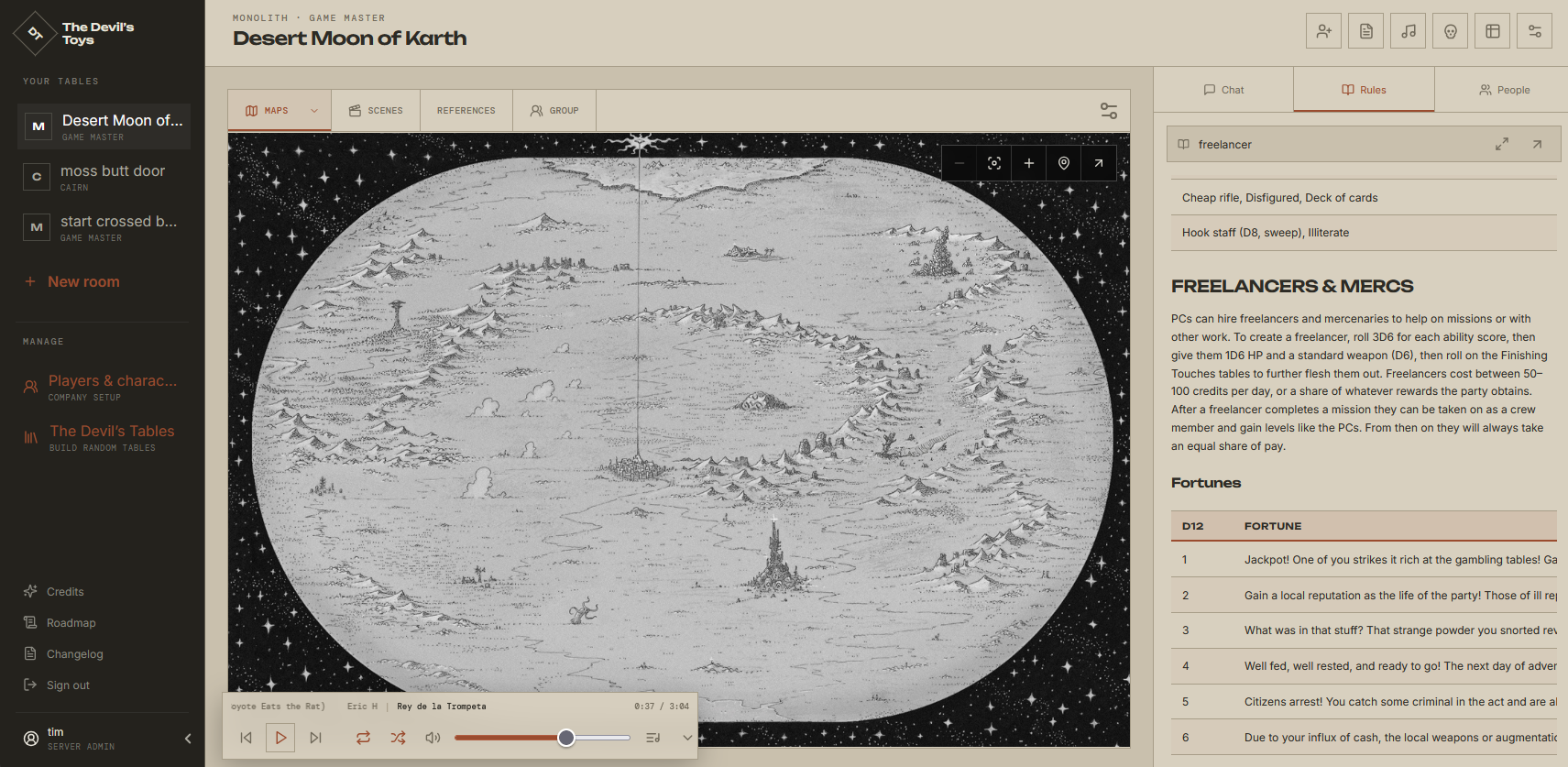
Lastly, I’m going to start running Desert Moon of Karth in August, using Monolith as the system. I wanted to make a VTT for this using some lessons from my Mothership VTT (which I can’t release for IP reasons; if I polish it more, I may reach out to TKG to see if they’d give permission). Rather than make it Monolith-only, I wanted it to support two systems, in part so that I can add more in the future should I feel the need. The obvious second system is Cairn, which Monolith is based on and which was released under CC BY-SA 4.0, meaning the rules are free to share and reproduce. This has been a lot of work, but it’s coming along nicely. You can see a not-ready-for-prime-time version on GitHub, and the screenshot below shows it in action.
What I Ran
Dungeon Crawl Classics - Chanters in the Dark
Following up on last month, I ran parts 2 and 3 of Chanters. Overall, I liked the adventure, but having run it, I really wish it had been a level 2 or 3 adventure with another adventure between it and Sailors. I feel like the Starless Sea is a really cool setting that both Sailors and Chanters mostly breeze past. It isn’t much of a factor in either, and I love the idea of an island-hopping adventure on an underground sea. Maybe I’ll work on that in the future.
Anyway, Chanters—I think one of the big triumphs of the adventure is the setting. The players find themselves in an ancient underground city with a dying population of beastmen who did not build the city but live there. These beastmen live in the shadow of a mysterious cult that is really into eyes—the beastmen’s eyes, to be exact. There are a few beastmen factions with competing goals, and I think the adventure could have devoted a little more space to faction interplay. It was mostly a non-factor in our adventure, partly my fault and partly the module’s.
The players’ goal is to escape this city; whether they want to help the more sympathetic beastmen is up to them. One sticky point in the adventure is that the players are presented with a 200-foot drop, and if they can get down it, they can bypass the adventure’s one dungeon. My players had no magical means to do this but had 50 feet of rope, and I decided they could scrounge for more if they wanted. So we went on a bit of a side quest to find some rope. The players climbed down and found themselves in the climactic scene of the adventure, having bypassed much of it.
There is an unkillable threat that the players need to get past to escape. Where it gets weird is that they escape by climbing the opposite wall from where they climbed down. This flows well if the players didn’t climb down 200 feet of rope, but down then up isn’t something that makes a ton of sense here. The party did have an NPC with them at this point, so I had her lead the way, hoping they would follow. They didn’t, instead running away from the beast and toward the adventure’s dungeon. We ended the session there and scheduled another.
The adventure’s dungeon might be its weakest part: four rooms, four combat encounters, and not a single alternative path to be found. As the players came in through the back, I let them start the hardest combat encounter with stealth, which ended up making it pretty easy. They cleared out the rest of the dungeon and did acquire a large stash of eyes, which they discovered during their escape could distract the monster.
And that led into the other weak point in the adventure. Escaping the beast is a climbing minigame, and I was really excited for this at first. The minigame has a little worksheet and a number of things going on, but it ended up being a drag in practice. The PCs make climbing roll after climbing roll while the monster rolls on a d3 table each turn. It’s just kind of grueling, and not in a fun “this is actually what climbing a cave wall would be like” kind of way.
At the end of the day, I think Chanters is a fine adventure. I’d object to the dungeon less if it were less central, but the module expects and encourages the players to go through it, and again, there is only one way through it. The final climb is a great idea but falls down on execution; there need to be fewer, higher-stakes rolls.
Mothership - Icarus
The third Mothership adventure I ran this quarter (don’t ask) was Icarus by Patrick McDavid. I like this adventure a lot. It’s a trifold adventure (which I don’t love for formatting and space reasons), but the basic conceit is that the players are on the first test flight of a faster-than-light ship. One thing I don’t love is that some of the adventure comes off as a little silly (Dr. Haste invented the FTL drive), but overall, it’s a great setup. You start the adventure with the FTL jump, and I think it has a nice spin on how that goes wrong. I enjoyed narrating it.
After the FTL jump goes wrong, the players are left on a ship slowly falling into the sun and have to save it or themselves. It has a pretty creepy central threat that I enjoyed, and overall, I think this was a great one-shot adventure: a lot of tension, a limited decision space on a fairly open map, and many chances for players to save the day or die trying.
One thing I will say about these trifold adventures is that they don’t need a lot of prep, but they feel hard to get a grasp on. I screwed up a detail of this adventure (which NPCs are on the ship) entirely because you’ve gotta sorta find details room by room. If this were, say, a 10-page adventure, I could read through it more easily, and it would have a page or two detailing the NPCs, so I wouldn’t have made that mistake. Another issue I had is that a random-event table can result in the NPC pilot dying, which would cause the ship to fall more rapidly into the sun. At least, I think so. The random event is that the bridge loses atmosphere. Maybe he’s in a vac suit? But it’s this kind of thing where I don’t want to have to think up second-order consequences on the fly when running a prewritten adventure. I think the Mothership trifold format can work, but it’s not for me. I don’t want 50-page Mothership adventures, but I really love a lot of the perfect-bound ones in the 20-page range. They offer a great balance of detail and brevity.
What I Played
Mythic Bastionland
We played sessions 2 and 3 of a short Mythic Bastionland campaign. When my friend said he was going to run this, I was very excited. It’s an incredibly cool game, and I’m glad to have given it a go.
The elevator pitch is that this is a traditional fantasy game about a land of magic, but with a very strong editorial focus. The players are knights; character creation is, in large part, seeing which knight (the Boulder Knight, the Trail Knight, etc.) you will be. The other really strong bit of editorial direction is the Myths. Your campaign is a sandbox, and that sandbox is full of myths. Which myths you encounter and resolve is left to fate. I’m having a little trouble describing it, but in play, it is a very interesting system: you randomly encounter various vignettes related to one myth or another as you cross the hex map.
I think the game does a lot of things right, but overall, I think it works better as a bit of RPG art than as a system. It does one very specific (but very big and vague!) thing, and I think it has some rough edges outside that focus. To get into this, I need to talk about one specific encounter we had. At the culmination of a quest, we ran into two bands of Knights (whom we’d encountered before) facing off. Our group hung back, then rushed in when one side seemed to be winning. There were four of us and four of them, so, as knights, we did the reasonable thing and split up into one-on-one combats. Which kinda suck? My knight had a weapon that rolls a d10, but it takes two hands. So my turns were: roll my d10 and, if I wanted to, roll a d12 as a Smite die. This is something of a push-your-luck mechanic—more on it later. If my d10 rolls less than 4, nothing happens; my opponent has 3 Armour, and you need a 4 to do damage. So my two-handed weapon has a 30% chance of missing in a game with no hit rolls! The combat system is more interesting when multiple dice are involved in attacks, but in this combat, I did the knightly thing and was rewarded with something like 5 rounds of do-nothing dice rolling. My opponent had 3 Armour and 13 Vigor, so with no other intervention, on average, it would take me over 5 rounds of combat to kill the guy. Actually, he could have gone down sooner, but now we’re too in the weeds. The core issue is that I’m rolling a d10, and getting 1–3 means my turn is over. Now, the Smite die lets you add a d12, but you have to make a save, and if you fail it, you can’t use the die again. You can use that same system on defense, and here’s my next beef. The game has a Guard value. This is effectively HP that gets reset every fight, and you start with 1d6 of it. And you more or less keep 1d6 of it. This is a very modern mechanic (temporary/resetting HP) with OD&D-level balancing. Low-level D&D was dangerous in part because you might roll a 1 for your HP at level 1, but that balances out as you advance. Here, you generally stay at your initial Guard, and if you do gain more, it’s in 1-point increments, so there is no way for you to catch up or balance out over time. In my mind, it’s just bad game design. My knight had 1 Guard and felt very fragile for that reason; the first hit would go right to my Vigor. Wait, wasn’t I talking about a Smite die? Well, you can use it to Deny. That blocks an attack, but you have to make a Spirit save, and mine was 17 on a d20. On average, my knight could be attacked 7 times before actually taking damage, assuming I didn’t use my Smite die to attack.
Now, you could say I’m playing the game wrong and that I shouldn’t worry about the math and tactical play. But what’s the point of combat rules if not to encourage that? The game mechanically said, “Whatever you do, don’t let them hit you,” and “Whatever you do, don’t get too aggressive because you have insane defenses as long as you play it safe.” And that’s fucking stupid and had no connection to the Mask Knight’s lore or my view of him. I know MBL didn’t invent this combat system whole cloth, so I’m interested to see whether these complaints carry over as I play other games in the broader family.
Now, I have one other complaint that is pretty specific to MBL, and it’s a bit of a weird one: there is too much stuff going on. The game is set up so you are constantly finding new stuff, which is cool, but I didn’t feel like our party had time to breathe with a big checklist of myths we could dig into more. At one point, it felt like we were doing sprint planning, trying to prioritize what we wanted to accomplish next and how to get there. It’s possible that in a longer campaign, there is more room to breathe, but I suspect it just means you’re in this state for longer with a more robust backlog.
I know I’m hard to please when it comes to systems. I’m a nitpicker, and if something rubs me the wrong way, I have trouble moving past it. With that context in mind, I’m happy to have played the game, and we might play more, and that sounds good to me! But I think the system has some issues, and at no point did I think to myself, “Let’s file the numbers off this and use it as a generic fantasy system.” I think this review on Reddit was good. It raises different points from mine as a player, but it rings true to me.
D&D 5.5E (with PvP!)
A friend is running a campaign for three players. They take the role of evil magic users and are up to evil-magic-user stuff—not entirely clear what, but it seems pretty evil. He wanted to have them interact with other parties and do some PvP, so we were called into action. Four of us formed a party ostensibly led by my character, a Harper attempting to investigate the evil on the High Moors. We had two intro sessions setting up our investigation, and last weekend, we had a joint session with both parties at the evil tower, ready to throw down.
Well, somewhat ready to throw down. They had just come from a fight, and one of the three was half-dead, but the other two seemed pretty hale and healthy. The encounter started rough for the good guys when our monk was shoved off the ledge where we found ourselves, and while he didn’t die, he missed the entire fight. Things were looking pretty bad for us. I was a thief, but my backstabs kept getting negated by magical reactions, a mechanic in 5E that I didn’t get to use once in this adventure because I’m a Thief and 5E is bad. However, as things were looking dire, one of our party members cast Hold Person on both evildoers. They failed their saves, and I finally found a defenseless target to stab to death. It sounds like that death won’t stick for evil wizards.
I had a lot of fun in the joint session, and I think a good portion of that was down to having eight people on a call playing D&D. That’s a lot more than most of my virtual play, and I don’t think it’s sustainable, but I enjoyed playing with the larger cast.
That said, it was mechanically pretty underwhelming. Everyone says D&D PvP is bad, and they’re right. Magic just breaks it, and having so many spellcasters in one fight meant it came down to a handful of important saving throws. Even our party, which took a lot of damage, could just keep healing people as they fell over. The D&D PvP haters are right.
More generally, I’m a 5E hater, and this didn’t do anything to change my mind; it just confirmed my biases. Combat is just so fucking slow and so fucking boring. This was something like a four- or five-hour session, and almost all of it was combat. I think I did eight or nine rounds, and three of those rounds were me moving with nothing to do, while two of them were spent stabbing corpses. So in four or five hours, I had time for three or four real turns of combat, and they were not that tactically interesting since I did the same thing every time. The system is just wordy, not deep.
Old World - Battle March
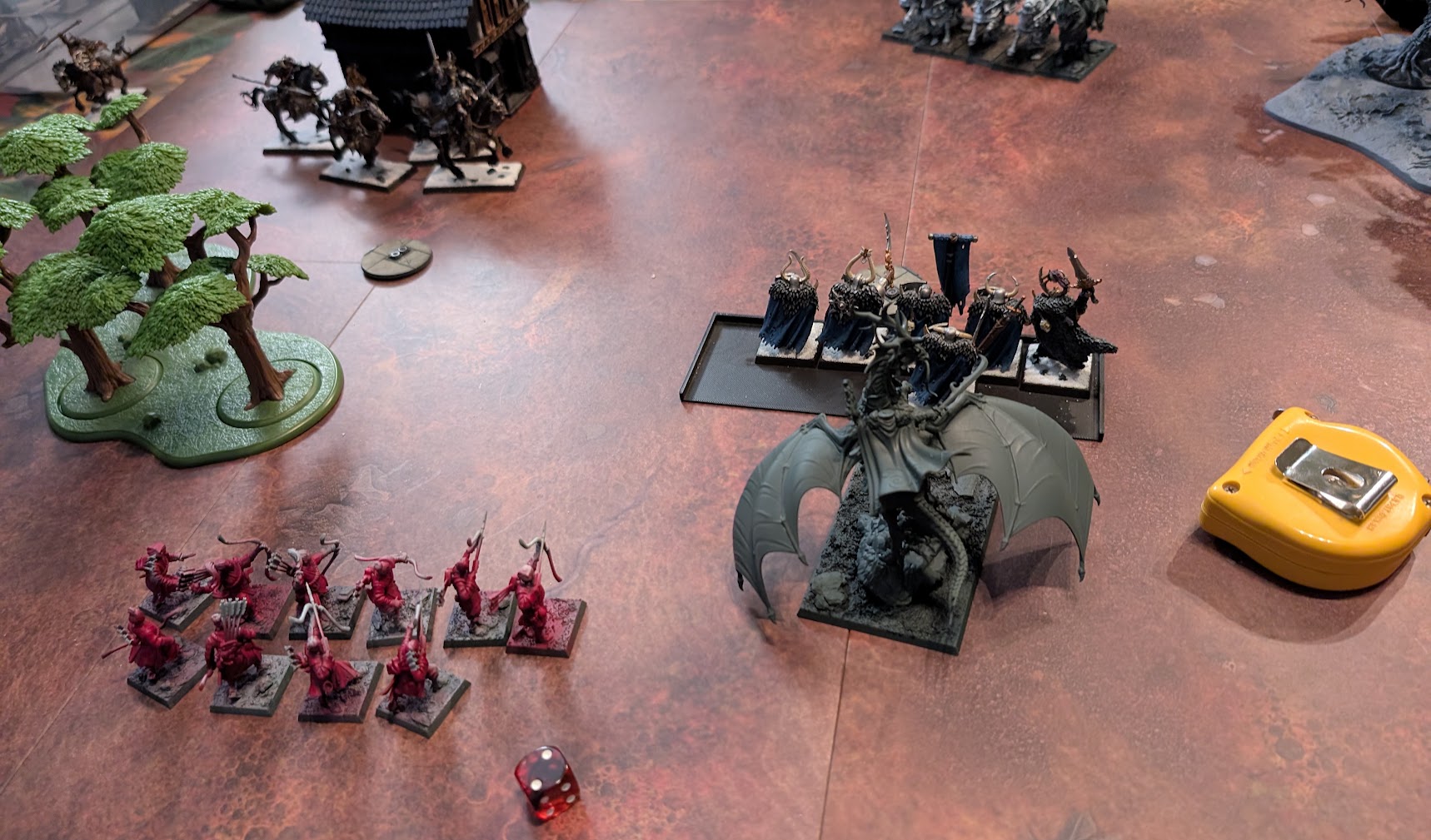
I played two games of Battle March with a friend. I hadn’t played Old World in a while, and this is the small-format version. We played 600 points, and I used it as a chance to get Cathay on the table for the first time, though there is still painting to do.
We ended up with two close draws. I was pleasantly surprised by how the game more or less just works at this point level. Battle March changes the army construction rules, but the end result is good and plays well.
Without a doubt, my favorite part of this is how it shakes up the meta. You can’t take dragons. And because you can’t take dragons, things like cannons are kind of dead weight. A smaller board also really helps infantry. So, all in all, I’m happy GW released this and look forward to playing more. My biggest concern is that games can be a little limited or swingy due to the number of units on the table, but I’ll see how that develops.
What I Hobbied
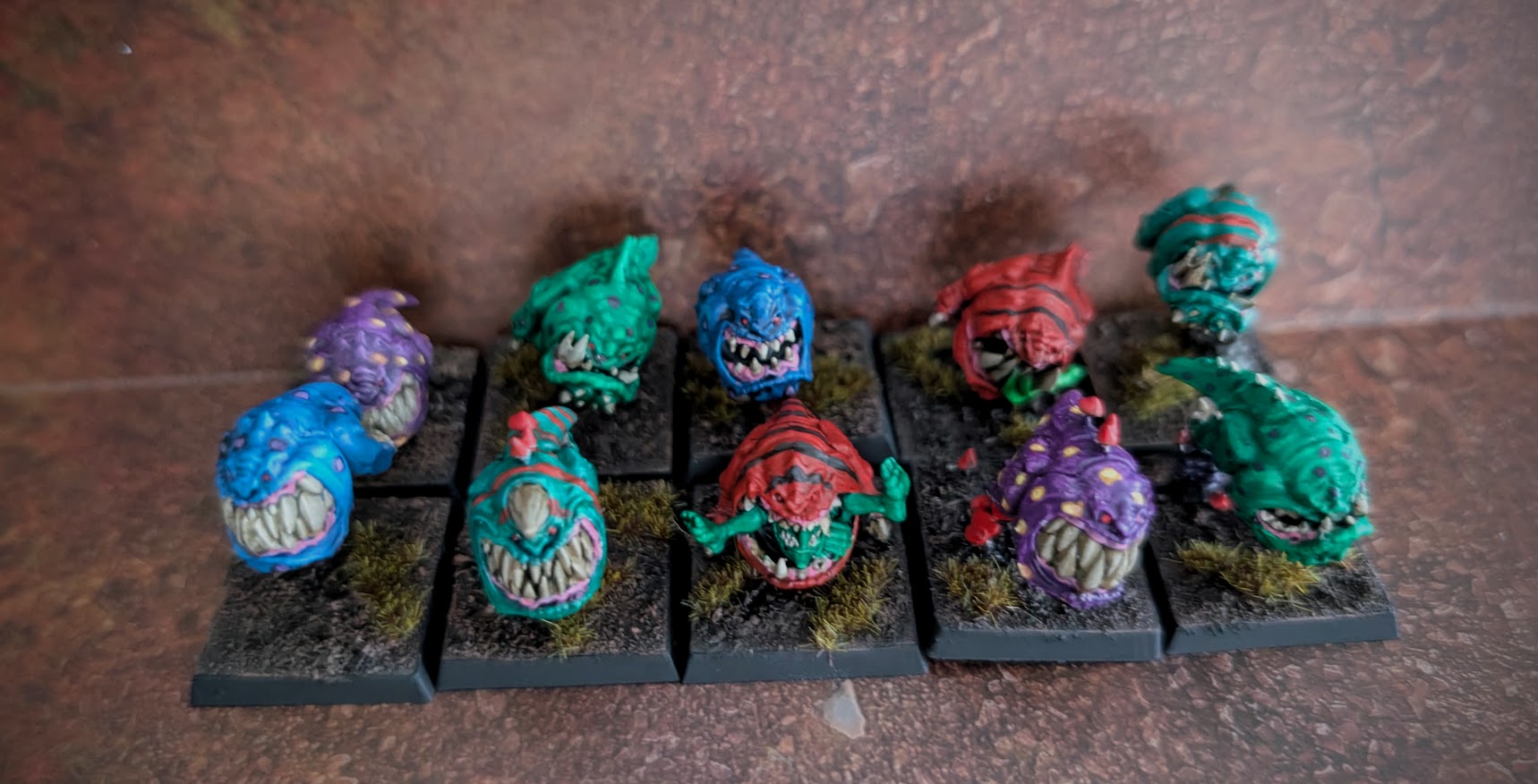
I had an “oh shit” moment with my hobby this month. After playing Warmaster on the Fourth of July, I gave myself a break from my September projects. And what do you know? Before long, it was near the end of the month, and I had only six weeks to finish three Warmaster armies, another 30-ish goblins, and a few dozen High Elves. Oh, also 10-ish dwarves. So I’m now focused on that stuff and have to put my dithering over the past few months (40K Orks, Armoured Clash Enlightened, Dystopian Wars Sultanate) to the side and really try to focus and crank stuff out.
The first target was something that has been a weird part of the project: 10 squigs and 10 squig hoppers. I did these as a batch of 20 for a good reason: I like having weird squig colors and was going to do two of each pattern in each unit. But that ended up being a mistake. I actually did a lot of work on these last month, but overly large batches kill my motivation, which certainly happened here. I should have done these as two or three batches. But I got back to them and am making progress. The hoppers will be finished this weekend, and then it’s time to start grinding out Warmaster units.
What I Bought
Anthony Huso Books
Anthony Huso has a really good blog, and I’ve heard nothing but good things about the modules he has put out. I picked up Castle of the Silver Prince and The Nightwolf Inn. Having started reading the latter, I can say it lives up to the hype. Huso is an AD&D 1st-edition die-hard, and with OSRIC 3.0, I’ve been interested in some Advanced Fantasy Gaming. I’m not sure when or if I’ll run these, but they’re inspired.
Necromunda: Skirmish
I’m very excited for this and will talk about it more in the future, but a new Necromunda edition means it’s time to get some more Necromunda stuff. So far, I really like what I’ve seen, and I want to try to organize a campaign this fall when I have a little more free time.
What I Watched
Aeronautica Imperialis - Warhammer TV
I don’t watch many of the Warhammer animations, and this reminded me why. It’s three episodes, each around 10 minutes, and the entire plot consists of some dogfights between Eldar and Imperial pilots. And god, who cares? I watched it with a friend and said to him, “You know, you can start with a cold open, but at some point, you have to catch the audience up on what’s going on.” And they never do.
I have very little to say about this, but I did like the end, which felt incredibly bleak. We were joking that Imperials had been fighting these same dogfights in the same place for generations, and the end of the series kind of supports that reading. So, yeah, my favorite thing about the series feels a little unintentional.
Games Workshop needs better writers, higher budgets, or to scrap this whole idea.
End of Evangelion
Evangelion: Death (True)² & Rebirth and The End of Evangelion were in US theaters a couple of weeks ago, and it was a real treat to see them. Eva was one of the first anime I watched (over a decade after Robotech, if that counts), and it is hands down one of my favorite… properties? in the world. I’ve seen both, but seeing D&B in US theaters for the first time was kind of cool, and seeing The End of Evangelion was incredible. Watching D&B also gave me some ideas for an Evangelion RPG campaign. There is at least one fan-made RPG, but I’d probably look at hacking or homebrewing something else. I think Evangelion would be an incredible setting for a campaign where the players take the roles of the characters from the TV show, and, as is canon in the universe (slight spoilers ahead), this would just be another retelling of the story that keeps repeating. Because of that, they could give the characters their own spin, and I could mix together the different sources of material along with some twists. This would require a lot of prep and the right group, but I suspect it will stay firmly lodged in the back of my mind.
Coming Up Next Month
So many Warmaster minis to do. This is going to be the focus; I need to be doing a couple of units a day on average, so it’s time to go, go, go. Because of that, I’m not really trying to set up much other gaming, with my other notable commitment being the start of Desert Moon of Karth, as mentioned at the top. Karth is a really cool setting, and I think Monolith will be a better fit for my DM style (and, honestly, the module) than Mothership.